 Available in US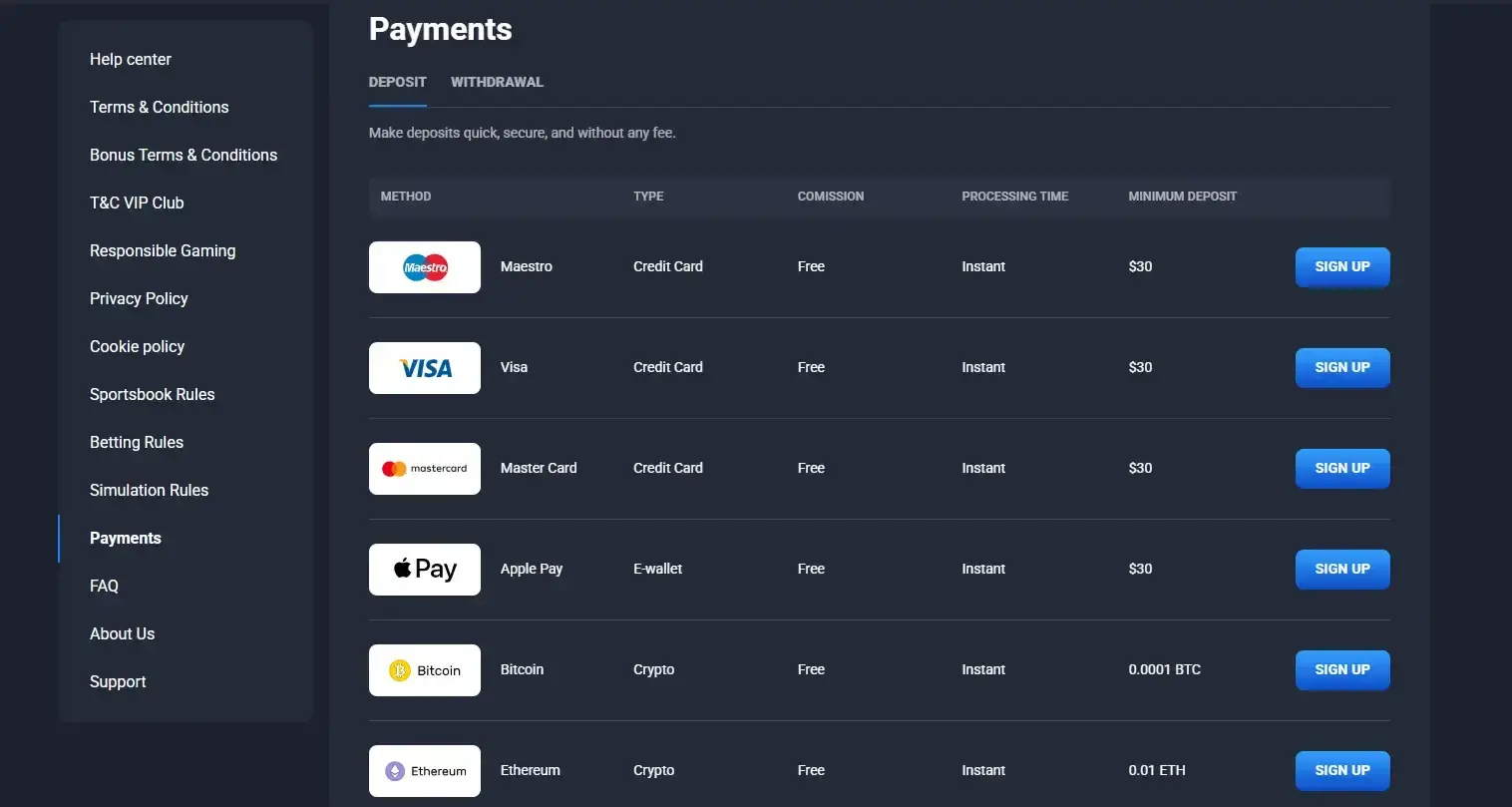
Payment categories visible at Lucky Hunter
Lucky Hunter supports a mix of conventional and cryptocurrency payment categories. The public payment material includes cards and e-wallets, while the same payment information also lists bank transfer and multiple cryptocurrencies including BTC, ETH, LTC, BCH, DOGE and USDT. This gives the cashier a broader mix than a card-only casino.
For an Australian account, however, method availability should be treated as an account-level cashier question. A globally published payment page can show what the platform supports without proving that every method appears for every Australian user, bank or transaction.
Cards and conventional payments
The current public payment page lists card options such as Visa, Mastercard and Maestro, as well as e-wallet and voucher-style methods. These are useful evidence of the platform’s conventional payment support. They are not a guarantee that a particular Australian-issued card will be accepted.
Issuer rules, account settings and cashier eligibility can affect what is actually displayed or approved. The practical check is simple: use the logged-in cashier as the final source for the methods offered to your account.
E-wallets and vouchers
Lucky Hunter’s public payment material includes e-wallet and voucher categories. These can be useful when a player wants to separate casino transactions from a primary card, but availability and withdrawal support are not necessarily symmetrical. A method that accepts deposits does not automatically have to be the route used for withdrawals.
Before depositing, check whether the cashier also shows the method on the withdrawal side and whether any account verification step is required. This avoids choosing a deposit route based only on its name in a public list.
Cryptocurrency support
The public payment information includes several cryptocurrencies: Bitcoin, Ethereum, Litecoin, Bitcoin Cash, Dogecoin and Tether are listed in the public payment information. Crypto support expands the available payment categories, but it also introduces network and wallet considerations that do not apply to ordinary card payments.
Confirm the asset and network shown in the cashier before sending funds. A crypto ticker alone is not enough to infer the required blockchain network, minimum transfer or final credited amount. Those transaction-specific details belong to the live cashier.
Bank transfer
Bank transfer appears in the public payment information. For Australian users, that does not justify assuming a particular local bank-transfer rail or PayID option unless it is actually displayed for the account. Generic bank transfer support and a specific Australian payment product are different claims.
If bank transfer is offered, read the cashier instructions carefully and use the beneficiary and reference information shown there. Do not reuse details from an old transaction if the cashier provides new instructions.
Minimum deposits and exact limits
The public payment page currently displays minimum-deposit information for listed methods, but exact amounts are freshness-sensitive and can differ by currency, method or account. The practical decision focus therefore stays on the live cashier rather than turning one public table into a permanent Australian limit schedule.
Before funding the account, check the minimum and any maximum displayed for the selected method. If your account is denominated in AUD, use the AUD figure shown by the cashier rather than converting a euro or dollar figure from another regional page.
Fees and processing labels
Lucky Hunter’s public payment page labels listed deposits as free and instant. That describes the operator-facing public table, not every possible external cost. Banks, card issuers, e-wallets or blockchain networks can have their own charges or processing behaviour.
For a payment decision, separate three things: the casino’s displayed fee, the payment provider’s possible fee and the time before the balance is actually available. The current cashier and your provider’s own terms are the relevant transaction-level sources.
Deposits are not withdrawals
A deposit-method list should never be copied automatically into a withdrawal guide. Cash-out routes can be narrower and may depend on the original funding method, verification status and account history. That is why Lucky Hunter withdrawals are covered separately.
Before making the first deposit, it is worth opening the withdrawal area if the account permits it. Knowing the available exit route can be more important than choosing the fastest way to fund the balance.
Australian account and AUD context
An Australian-facing registration flow showed Australia as the country option and AUD as the account currency option. That is useful context for an Australian payment review because it means the account can be considered in local-currency terms rather than assuming a foreign base currency.
Still, an AUD account does not prove that every Australian banking method is supported. Currency selection and payment-method eligibility are separate account facts and should be evaluated separately.
A practical cashier check before depositing
- Confirm the account currency shown in the cashier.
- Compare only the methods actually offered to your account.
- Check the displayed minimum and maximum for the selected route.
- Read any fee or processing label before confirming.
- For crypto, verify both asset and network.
- Check the withdrawal area so you understand the likely cash-out route.
- Keep transaction confirmations until the balance is reconciled.
Account verification and payment ownership
Payment activity and account verification can intersect. The safest approach is to use payment methods that belong to the account holder and to keep registration details consistent with payment information. Exact document requests belong to the dedicated verification guide and should not be invented from generic KYC practice.
If the cashier or support channel requests verification for a transaction, follow the current account instruction rather than relying on a static checklist from an unrelated casino.
How payments fit the wider review
Payments are one part of the Lucky Hunter decision. The main Lucky Hunter Australia review connects banking with games, bonuses, mobile access and trust context, while the registration guide covers the account setup that comes before using the cashier.
For banking specifically, the key distinction is not a longer method list. It is knowing which facts are platform-wide and which must be confirmed in the live Australian account cashier.
FAQ
What payment types does Lucky Hunter support?
The public payment information includes conventional methods such as cards and e-wallets, bank transfer, and multiple cryptocurrencies.
Does Lucky Hunter support crypto?
Yes. The public payment information lists BTC, ETH, LTC, BCH, DOGE and USDT among supported payment options.
Are all public payment methods guaranteed for Australian accounts?
No. Exact account-level Australian cashier availability should be confirmed in the logged-in cashier.
Can I assume a deposit method is also available for withdrawal?
No. Deposit and withdrawal availability can differ, so check the withdrawal area separately.
Where should I check current limits?
Use the live cashier for the selected account, currency and payment method.
What to confirm before making a payment
Start with the cashier option that is actually available to your account. Check the currency, the payment method name, the minimum and maximum shown for that route, and any fee or processing note before you confirm a transaction. For cards and e-wallets, also check whether the same method appears in the withdrawal area. For crypto, verify the exact asset and network because a familiar ticker does not by itself identify the correct transfer route.
The most useful comparison is between methods shown side by side in the same account. One option may be convenient for deposits but less practical for withdrawals, while another may have clearer limits or a simpler verification path. Looking at both funding and cash-out options before the first deposit helps avoid choosing a method purely because it appears first or has a familiar brand name.
Keep the transaction receipt or confirmation until the balance is credited and any withdrawal is complete. If a method disappears, a limit changes, or an extra verification step appears later, use the information currently shown in the cashier and account messages rather than relying on an older copied list. That keeps the payment decision tied to the conditions that apply to the transaction you are actually making.
If you are deciding between a conventional method and crypto, compare the practical workflow rather than assuming one category is automatically faster. A card or e-wallet may involve issuer approval, while a crypto transfer depends on the correct network and wallet details. In either case, the useful questions are the same: what the cashier shows for your account, what you will need to complete the transaction, and whether the route also works sensibly when you later want to withdraw.
The full picture is in the Lucky Hunter review for Australia.
Cashing out is covered separately under withdrawals.
This material was created by the Lucky Hunter team.
