 Available in US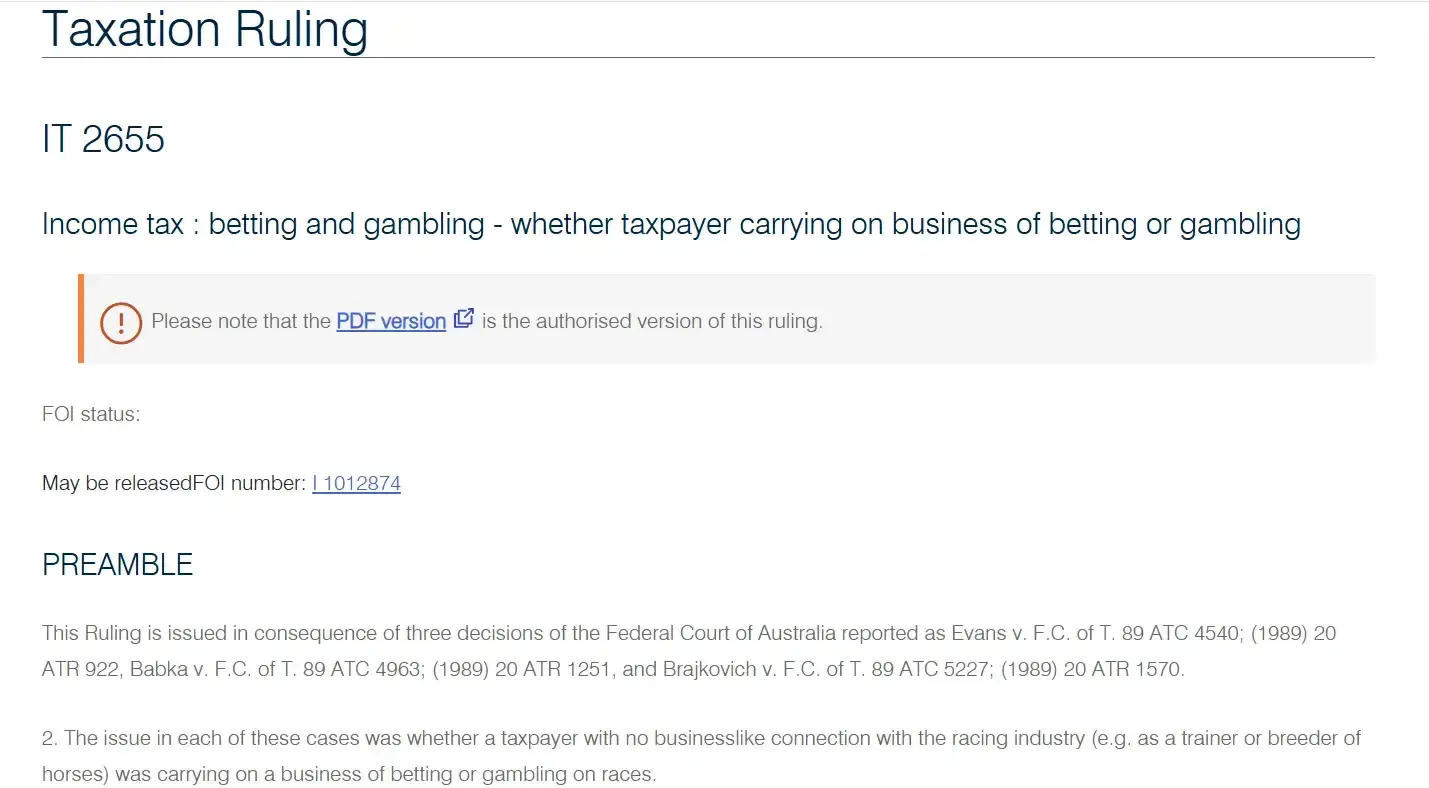
The basic Australian tax distinction
The tax question is not best approached by asking whether Lucky Hunter itself makes a win taxable. Australian tax treatment turns on the taxpayer’s circumstances and the nature of the activity. The ATO material distinguishes ordinary gambling and prize outcomes from situations in which betting or gambling amounts to a business.
For recreational gambling, the practical starting point is that ordinary winnings are generally outside assessable income. This is why a casual casino player should not assume that every payout must be entered as ordinary taxable income merely because money was received. Equally, that general position should not be converted into an absolute statement that gambling can never produce taxable income.
The business exception matters because Australian tax law looks at what the person is actually doing. A person whose activities are sufficiently systematic and business-like can be in a different position from someone gambling for recreation. The ATO’s Taxation Ruling IT 2655 specifically accepts that a mere punter can carry on a business of betting or gambling, while observing that such a conclusion is rare and fact-dependent.
What “carrying on a gambling business” means
There is no useful one-line test such as a fixed annual winnings figure. IT 2655 instead points to the criteria developed in Australian cases. The overall character of the activity matters. The ruling notes that chance is normally a predominant ingredient in mere punting and that this often weighs against characterising ordinary betting as a business.
That makes frequency alone an incomplete test. Playing often does not automatically establish a business, just as a single large win does not by itself convert recreation into business income. The relevant inquiry is broader: the organisation, scale and business-like character of the activity must be considered together with the other facts.
The ruling also notes that involvement in other business activities in the racing industry can make it more likely that betting activity is business-like. That example is useful because it shows why context matters. The question is not simply whether a person is skilled, profitable or enthusiastic, but whether the activity as a whole has the character of a business.
A large casino win is not a standalone tax test
A common mistake is to treat the amount of a win as the decisive issue. The ATO material does not establish a general dollar threshold at which a recreational gambling win automatically becomes assessable. The legal character of the activity remains the central issue.
For a Lucky Hunter player, this means that the casino balance, withdrawal size or number of sessions should not be used as a substitute for the Australian tax test. Those facts might form part of a wider factual picture, but none is presented here as an automatic trigger. This is also why a casino review cannot responsibly tell an individual that a particular withdrawal is taxable or tax-free without considering that person’s circumstances.
The same caution applies in the opposite direction. A person should not assume that calling themselves a recreational player settles the matter if their actual activities have developed into an organised business. Labels are less important than the facts.
Winnings, losses and the business distinction
The distinction can affect more than the treatment of winnings. IT 2655 records the Australian position developed through the relevant betting cases and notes that, for a mere punter, winnings have not been held assessable and losses deductible. Where a genuine gambling business exists, the tax analysis can be different.
That is an important reason not to treat gambling losses as an automatic personal tax deduction. The recreational treatment of winnings is not a free-standing rule that lets a player choose whichever treatment is favourable for wins and losses. The character of the activity needs to be assessed consistently.
If a person’s gambling has become substantial enough that the business question is genuinely uncertain, individual tax advice is more useful than a casino-specific article. Records of activity can also become important when facts must later be explained. The tax overview does not prescribe a particular record set because the appropriate evidence depends on the circumstances.
Online gambling does not create a separate recreational rule
The fact that play occurs through an online casino does not by itself answer whether the player is carrying on a business. The general distinction remains between ordinary recreational activity and activity that has the character of a business.
For that reason, this tax context should be kept separate from the Lucky Hunter regulatory analysis. Gambling regulation and income-tax treatment concern different legal questions, so one should not be used as a shortcut for deciding the other.
It is equally important not to infer tax treatment from the currency used for a deposit or withdrawal. The ATO has separate guidance for crypto assets received through prizes and gambling. That guidance says certain gambling winnings and losses are excluded directly from capital gains and capital losses, while a crypto asset kept after it is won can later have CGT consequences when disposed of. That is a crypto-asset issue arising after acquisition, not a general rule that turns an ordinary gambling win into taxable income.
Why crypto winnings can create a later tax question
The ATO’s current crypto guidance provides a useful example of why the transaction after a win can matter independently of the win itself. If a crypto asset is won and then retained as an investment, a later disposal can produce a capital gain or capital loss. The ATO states that the cost base is the asset’s market value at the time it was won.
This distinction prevents two separate questions from being collapsed into one. The first is the treatment of the gambling outcome. The second is what happens after a person holds an asset and later disposes of it. A player dealing with crypto should therefore examine the relevant ATO crypto guidance for their circumstances rather than assuming the general recreational-gambling rule answers every later transaction.
Practical questions for Australian recreational players
- Do I automatically pay income tax because I won at an online casino?
- No automatic conclusion follows merely from receiving a recreational gambling win. Ordinary recreational gambling winnings are generally not assessable, while gambling conducted as a business can be treated differently.
- Is there a published general winnings threshold that changes the answer?
- The ATO material used here does not provide a general dollar threshold that turns a recreational win into business income. The character and facts of the activity matter.
- Does regular play automatically make me a professional gambler?
- No single fact is presented by the ATO ruling as an automatic test. The ruling says each case depends on its own facts and points to the overall criteria developed in Australian case law.
- Can I automatically deduct recreational gambling losses?
- No. The ATO ruling’s discussion of mere punting does not support treating ordinary recreational losses as automatically deductible.
- Does Lucky Hunter decide the Australian tax treatment?
- No. Australian tax treatment is determined under Australian tax law and the taxpayer’s circumstances, not by a casino’s description of a transaction.
When the general rule is not enough
The general recreational position is useful for orientation, but it is not a personal ruling. A person whose gambling is organised, extensive or closely connected with other commercial activity may need to consider the business question in detail. Crypto holdings can also create later tax events that are separate from the original gambling outcome.
When the facts are unusual or significant, use current ATO guidance or seek advice suited to the individual circumstances. This is particularly important where a person is deciding whether income or losses belong in a tax return, because the answer can depend on facts that a general casino guide cannot establish.
How this fits into the Lucky Hunter Australia guide
The tax coverage is deliberately narrow. It explains the Australian tax context that can matter to readers of the Lucky Hunter casino Australia review; it does not turn the broader review into tax advice. Product questions such as games, payments and account processes are separate from the income-tax classification discussed here.
For questions about the operator and the Australian regulatory environment, use the dedicated trust section. Keeping those topics separate avoids implying that tax treatment determines a casino’s regulatory position, or that regulatory status decides whether an individual’s gambling winnings are assessable.
Key takeaway
For ordinary recreational gambling in Australia, winnings are generally not assessable income. The important exception is gambling carried on as a business, and the ATO says that question depends on the facts and is rare for a mere punter. There is no substitute here for assessing the actual character of the activity. If the business boundary or a later crypto disposal is relevant to you, check the current ATO material for the specific issue.
The full picture is in the Lucky Hunter review for Australia.
The licensing framework is on the ACMA status page.
This material was created by the Lucky Hunter team.
