 Available in US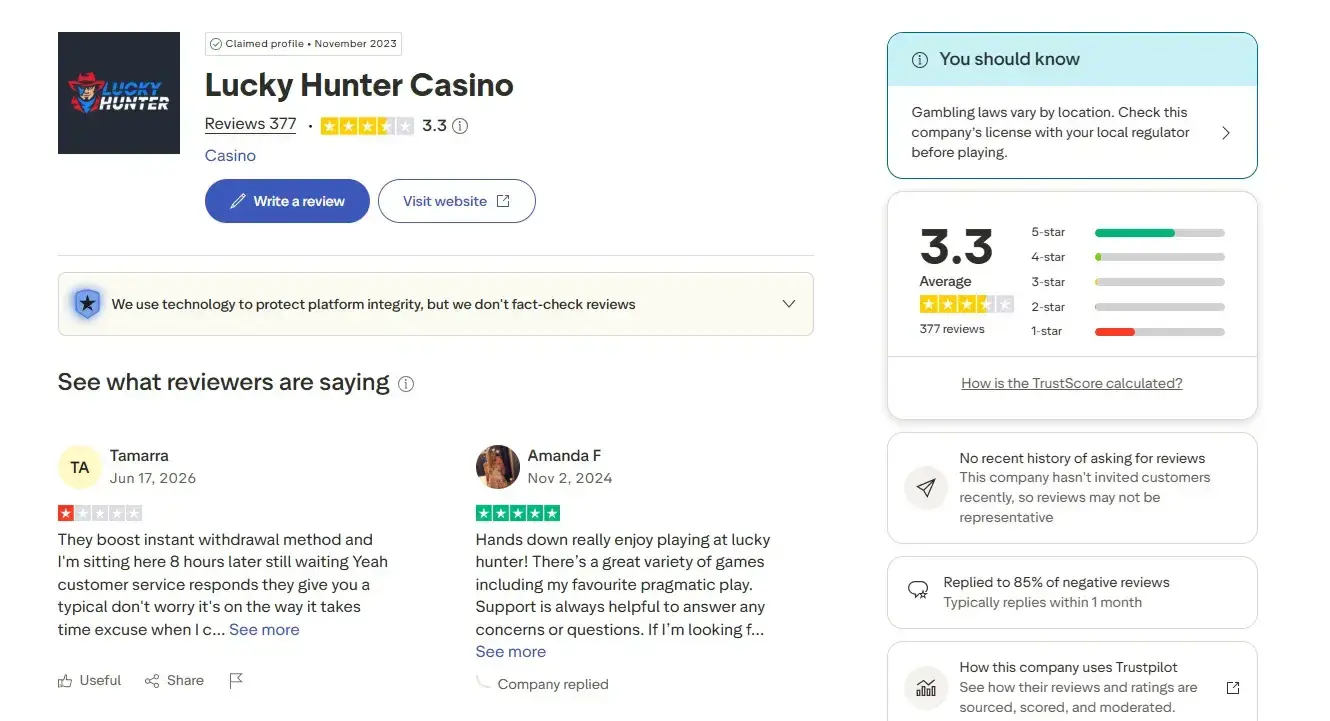
Lucky Hunter’s public reputation is mixed. Current Trustpilot material contains both strong positive ratings and a substantial group of negative reviews, while complaint databases show recurring disputes involving withdrawals, verification, support responsiveness and account-control requests. These reports are useful as pattern evidence, not as proof that every allegation is correct. The safest way to read Lucky Hunter complaints is to separate what a reviewer says happened, how the casino responded, and whether an independent complaint platform recorded an outcome.
What the current review picture shows
Trustpilot’s Lucky Hunter Casino profile currently sits in the middle rather than at either extreme. The profile shows hundreds of reviews, with many five-star ratings but also a sizeable one-star share. That distribution is more informative than quoting only the headline score because it shows that experiences are polarised.
Positive reviewers mention game choice, helpful support, straightforward verification and withdrawals they considered fast. Negative reviewers describe delayed withdrawals, frustrating support exchanges, account-closure or responsible-gambling requests, verification problems and disputes about promotional conditions. These are user accounts. They should be attributed as such and not rewritten as findings of fraud or misconduct.
Why a headline rating is not enough
A review score compresses different experiences into one number. It does not tell a reader whether recent complaints concern the same issue, whether older complaints have been resolved, or whether reviewers were discussing bonus play, cash play, KYC or account closure. Looking at the underlying themes gives more decision value.
Trustpilot also explains that reviews express individual users’ opinions rather than Trustpilot’s own conclusions. The Lucky Hunter profile includes company responses to many negative reviews. Those responses provide context, but they do not independently verify either side of a dispute. They are best read alongside the original review and, where available, a complaint-resolution record.
Withdrawal complaints are a recurring theme
Several public reviews describe dissatisfaction with withdrawal timing or rejected withdrawals. Some reviewers say they waited longer than expected; others dispute how bonus or reward conditions affected the amount they could cash out. Because individual account histories, verification status and promotional terms can differ, these reports do not establish a universal Lucky Hunter withdrawal time or a universal payout outcome.
What they do establish is a recurring topic worth checking before depositing. A reader can reduce ambiguity by reading the applicable withdrawal and bonus terms before play, keeping records of deposits and promotions, and completing requested verification promptly. Our dedicated Lucky Hunter withdrawal guide focuses on the payment process rather than using complaints to invent exact limits or processing times.
Verification and KYC complaints
Complaint databases also contain cases in which players say verification took longer than expected or that additional documents were requested. AskGamblers, for example, lists Lucky Hunter complaints involving verification delays and document disputes. Some entries are marked resolved, which is important context: the existence of a complaint is not the same as an unresolved finding against the casino.
KYC disputes are especially easy to oversimplify. A public complaint rarely provides the complete risk review, transaction history or internal compliance record behind a request. For that reason, the review analysis does not turn complaint anecdotes into a fixed list of documents or a promised verification timetable. The useful signal is that verification can become a point of friction and that players should keep account, identity and payment details consistent.
Support responsiveness and account-control requests
Another recurring theme concerns support. Some positive reviewers describe support as helpful, while negative reviewers describe generic replies, slow email responses or being redirected between chat and email. Public complaint records also include account-closure and self-exclusion disputes in which users said their requests were not handled as quickly as they expected.
These accounts deserve attention because account-control requests can be time-sensitive. At the same time, a review page cannot determine the full facts of an individual support case. The practical approach is to preserve copies of requests and replies, use the contact channel specified for the request, and escalate through the available complaint route if the issue remains unresolved.
Bonus-condition disputes need careful reading
Some negative reviews involve bonuses, maximum winnings or other promotional restrictions. These cases are difficult to generalise because a condition attached to one promotion may not apply to ordinary cash play or to another offer. A complaint about a particular reward should therefore remain tied to that reward rather than becoming a claim that every Lucky Hunter balance is subject to the same rule.
Before accepting a promotion, check the current terms that apply to that specific offer. If a dispute arises, keep the version of the terms, saved copies of the offer and transaction records. This creates a clearer record than relying on memory after wagering has taken place.
What complaint databases add
Complaint platforms can add structure that ordinary star reviews lack. AskGamblers publishes complaint entries and labels outcomes such as resolved. Casino Guru also publishes individual complaint cases with a public discussion and resolution process. These databases can help a reader distinguish an allegation that was posted from a dispute that went through a documented mediation process.
They still have limits. A mediator sees the evidence submitted through its process, not necessarily every internal record held by the operator. Different platforms also use different rules and rating systems. The most useful approach is therefore to look for repeated themes across independent sources instead of treating one complaint, one score or one verdict as definitive.
Positive feedback matters too
A fair reputation assessment should not collect only complaints. Lucky Hunter’s review profile also contains positive reports about game variety, support, verification and withdrawals. These experiences show why the overall picture is mixed rather than uniformly negative.
Positive reviews have the same evidentiary limitation as negative ones: they describe individual experiences. A fast withdrawal reported by one user does not guarantee the same timing for every payment method and account, just as a delayed withdrawal reported by another user does not prove that all withdrawals are delayed. Patterns become more useful when they repeat across time and sources.
Australian reviews and regulatory evidence are separate
Some public reviews are posted by users identified as being in Australia. That can help demonstrate that Australian consumers have discussed the brand, but a reviewer’s location does not establish the operator’s regulatory status. That question belongs to regulator sources rather than review profiles.
For that reason, the separate Lucky Hunter regulatory analysis examines the operator and ACMA material. Keeping the two topics apart avoids using complaints as regulatory evidence or using regulatory status as evidence that every player experience will be satisfactory.
How to read Lucky Hunter reviews more critically
- Check the date. Recent reviews are more useful for current service patterns than very old ones.
- Separate cash play from bonus play. Promotional conditions can materially change a dispute.
- Look for the casino’s response, but treat it as one party’s account rather than independent verification.
- Check whether a complaint platform records an outcome such as resolved or rejected.
- Look for repeated themes across independent sources instead of relying on one dramatic story.
- Do not infer exact withdrawal or KYC rules from anecdotes; use current terms for those details.
What would concern us most?
A single angry review is weak evidence. A repeated issue across recent reviews and structured complaint records deserves more attention, particularly when it concerns access to funds, identity verification or account-control requests. In Lucky Hunter’s case, withdrawal, verification and support themes recur often enough to be relevant to a prospective player’s due diligence.
That does not justify labelling every complaint true or the operator fraudulent. It justifies checking the relevant terms in advance, keeping records and deciding how much uncertainty you are comfortable with. Reputation research is most useful when it changes what you verify before committing money, not when it supplies a dramatic label.
Frequently asked questions
Are Lucky Hunter complaints proof that the casino does not pay?
No. Public reviews and complaints document what individual users allege and, in some cases, how the casino or a mediator responded. They do not prove a universal payout outcome.
What issues appear most often?
Across current review and complaint sources, recurring themes include withdrawals, verification, support responsiveness and account-control requests. Positive reports about support and withdrawals also appear.
Should I trust the Trustpilot score alone?
No. Read the rating distribution, recent reviews, company replies and other complaint sources. A single aggregate score hides the reasons behind positive and negative experiences.
Do Australian reviewer locations establish Lucky Hunter’s regulatory status?
No. Reviewer location and regulatory status are separate matters. Regulator sources should be used for the Australian enforcement position.
A practical reputation-checking method
Start with recent reviews rather than sorting only by the most dramatic rating. Read a sample of positive, neutral and negative experiences, then group them by topic. If withdrawals appear repeatedly, compare those reports with the current withdrawal terms. If verification appears repeatedly, check whether complaints describe the same stage of KYC or different document requests. This keeps reputation research tied to decisions a player can actually make.
Next, distinguish a raw review from a mediated complaint. A star review records one person’s account. A complaint database may add correspondence, an operator response and a resolution label. Neither format is perfect, but the second can provide more context about whether the parties engaged with the dispute. Finally, check dates: service procedures and terms can change, so a group of recent reports generally deserves more attention than an isolated old complaint.
What not to infer from reviews
Reviews cannot establish a fixed payout percentage for an individual player, prove that a game is manipulated, or establish a universal processing time. They also cannot establish regulatory status. Strong language such as “scam” is common in dissatisfied customer reviews, but repeating that label as an editorial fact would erase the distinction between allegation and evidence.
The same caution applies to praise. A five-star report about a fast cashout does not establish a guaranteed withdrawal speed. The editorial value lies in comparing recurring themes, dates and outcomes, not promoting the strongest wording from either side.
Bottom line on Lucky Hunter’s reputation
Lucky Hunter has neither a uniformly positive nor uniformly negative public reputation. Review sources contain many favourable experiences alongside a meaningful body of complaints. The most persistent negative themes concern withdrawals, verification and support, while positive reviewers report satisfactory games, assistance and payment experiences. Treat those reports as signals for further checking rather than adjudicated facts. For Australian readers, combine this reputation evidence with the separate Australian regulatory analysis and the broader Lucky Hunter Australia guide.
The full picture is in the Lucky Hunter review for Australia.
What applies to winnings is set out in gambling tax in Australia.
This material was created by the Lucky Hunter team.
